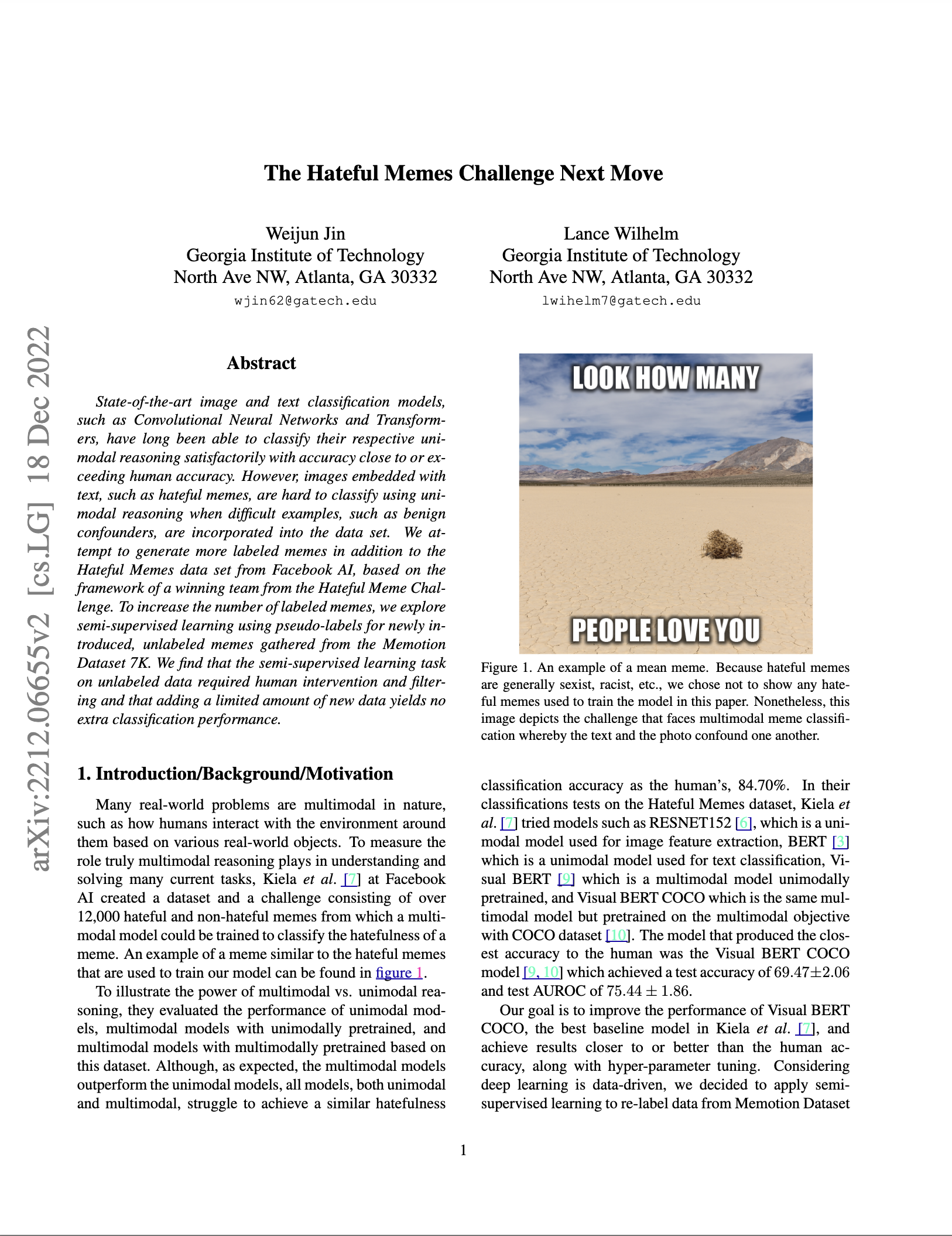
Hateful Memes Challenge - Next Move
Background
For my final project in CS7643 (Deep Learning) at Georgia Tech, our team took on Facebook AI's Hateful Memes Challenge. The dataset is built around "benign confounders": memes where the image alone and the caption alone are each harmless, but putting them together makes the meme hateful (or vice versa). This design requires a model to evaluate both modalities together instead of relying on text or image features alone.
The original dataset has only 10,000 labeled memes, and top models still trailed human accuracy (84.7%). Our hypothesis was straightforward: if we pull in unlabeled memes from the Memotion 7K dataset and pseudo-label them with a FixMatch-style semi-supervised loop, can we bring a fine-tuned Visual BERT model (pretrained on COCO) closer to human accuracy?
Approach
We started from Team HateDetectron's baseline setup using Facebook AI's Multimodal Framework (MMF) and Visual BERT pretrained on COCO, inspired by Velioglu and Rose's winning approach. To expand the training data, we combined the Hateful Memes dataset with Memotion 7K (bringing the pool to 19,132 memes total) and adapted the FixMatch semi-supervised algorithm (Figure 1).
For image features, we extracted region embeddings with a ResNeXT-152 Mask-RCNN model trained on VisualGenome (2048-dimensional visual embeddings) and projected them into the text embedding space before feeding both into Visual BERT's transformer layers (Figure 2).
Our initial labeled training split had 8,928 memes. It combined the Hateful Memes training set, Dev Seen, and 328 reliably labeled memes from Memotion 7K. After fine-tuning Visual BERT on that split, we ran inference on the remaining unlabeled Memotion 7K memes and kept high-confidence predictions as pseudo-labels, giving us 1,534 pseudo-labeled examples.
Following FixMatch, we applied strong image augmentations like cutout (Figure 3) to those 1,534 pseudo-labeled memes and appended them to the training set for 10,462 training examples total.
When retraining on those pseudo-labels lowered our test metrics, we checked whether noisy labels had caused the drop. We manually audited 822 memes that the model had pseudo-labeled as hateful and found that only 282 actually belonged in that class. We retrained a final time with only those 282 manually filtered examples.
Experiments and Results
We evaluated every stage on the unseen test split using accuracy and AUROC, training with cross-entropy loss and Adam. A grid search produced two strong hyperparameter configurations (Table 1):
| Model Hyperparameters | 1 | 2 |
|---|---|---|
| Steps | 3000 | 3500 |
| Learning Rate | 0.3 | 0.6 |
| Learning Rate Decay | warmup linear | warmup cosine |
| Warm Up | TRUE | TRUE |
| Warm Up Steps | 2000 | 500 |
| Batch Size | 32 | 80 |
| Optimizer Learning Rate | 5e-5 | 5e-5 |
Adding the 328 clean, human-labeled Memotion examples consistently helped both models, raising Model 2 from 76.84 to 78.45 test AUROC (Table 2). Once we added the 1,534 automatic pseudo-labels, however, both accuracy and AUROC dropped. Even swapping in our 282 hand-filtered pseudo-labels failed to beat the clean HM + Memotion 328 run, and it noticeably lowered scores for Model 2.
| Dataset | Model | Validation Acc. | Validation AUROC | Test Acc. | Test AUROC |
|---|---|---|---|---|---|
| Hateful Memes (Baseline) | 1 | 68.33 | 73.59 | 70.30 | 75.23 |
| 2 | 70.37 | 72.91 | 72.60 | 76.84 | |
| HM + Memotion 328 | 1 | 71.30 | 74.07 | 72.35 | 76.87 |
| 2 | 74.26 | 74.57 | 73.10 | 78.45 | |
| HM + Memotion 328 + Pseudo-labeled 1,534 | 1 | 69.07 | 75.00 | 69.80 | 75.88 |
| 2 | 70.00 | 75.28 | 72.30 | 77.83 | |
| HM + Memotion 328 + Filtered Pseudo-labeled 282 | 1 | 70.56 | 75.14 | 71.90 | 76.55 |
| 2 | 68.33 | 73.50 | 69.85 | 74.28 |
Takeaways
It turned out to be a useful negative result:
- Extra clean data helped, pseudo-labels did not. Adding 328 real labeled examples from Memotion gave the biggest gain (+1.61 test AUROC on Model 2).
- Unchecked pseudo-labeling breaks down on subtle multimodal tasks. Out of 822 high-confidence "hateful" pseudo-labels, only 282 held up under manual review—roughly two-thirds were false positives.
- Distribution shift matters. Memotion memes look and read differently from Facebook's carefully constructed test set of confounders, so even after manual filtering, the extra examples shifted the training distribution away from the test set.
If I revisited this today, I would skip pseudo-labeling Memotion altogether and focus on stronger text and vision backbones, ensembling, or pulling external captions that add entity and background context for the images.